Heritage / Conservation / Philosophy
The Lion We Did Not Invent
A Reflection on Symbol, Habitat, and the Limits of Metaphor
A forest-dwelling lion, Kaffa Biosphere Reserve, southwestern Ethiopia
There is a particular kind of vanity in choosing a symbol for your own purposes and then discovering, later, that the symbol was never yours to choose. It existed before you. It will outlast your use of it. At best, you have borrowed something true and called the borrowing a decision.
When a company places a lion on its crest, the convention is well understood: the lion stands for sovereignty, for the historical weight of the Ethiopian imperial line, for a kind of inherited dignity that costs nothing to claim because it is purely symbolic. Heraldry has always worked this way. The eagle never asked to represent empires. The Lion of Judah never consented to appear on flags.
But somewhere in the cloud forests of southwestern Ethiopia, in the exact region from which every coffee plant on Earth descends, there is a population of lions that does not know it has been made into a symbol of anything. It does not hunt allegorically. It does not pose for crests. It moves through dense montane canopy, the same canopy under which wild Coffea arabica first grew, hunting in a manner so distinct from its savannah relatives that for a long time most of the world scarcely knew it existed at all.
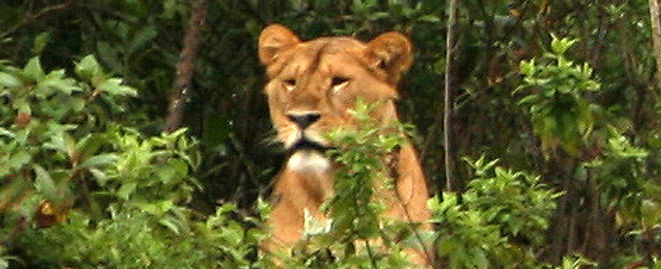
It took conservationists, working alongside knowledge long held by local communities, to document what could no longer be denied: lions living not on open plains but within rainforest ecosystems. One of the very few forest-dwelling lion populations known to science. Hidden, in effect, within the birthplace of coffee itself.
This is the part that should give any company using a lion as its emblem pause—not pride exactly, but something closer to vertigo. The symbol was never abstract. It was always, this entire time, an actual animal breathing actual air in the actual forest from which the coffee originates.
We did not select a metaphor.
We inherited a fact.
What makes this more than coincidence is the ecological mechanism connecting the two.
Specialty coffee growers have long understood that shade is not decorative. The dense forest canopy beneath which Ethiopian heirloom arabica evolved slows the ripening of the coffee cherry, allowing sugars and aromatic compounds to develop with greater complexity. The result is a cup profile that has distinguished Ethiopian coffee for centuries. The canopy is not scenery. It is part of the process.
The same canopy structure—intact, layered, and biologically diverse—is also what allows a forest-dwelling lion population to exist at all. Remove the forest for higher-yield sun cultivation and more is lost than habitat. The ecological architecture itself begins to disappear.
The consequence is remarkable.
The same forest integrity that produces extraordinary coffee is the forest integrity that sustains one of the world's most unusual lion populations.
This is not poetry imposed upon agriculture after the fact.
It is a single ecological reality with two visible outcomes—one we taste and one most of us will never see.
It would be dishonest to stop here on the comfortable note.
Lions in Ethiopia survive under increasing pressure, and the communities living along the forest edge often bear the costs directly. Livestock predation is not a symbolic concern. It is an economic reality. Conservation cannot succeed by asking rural families to absorb losses indefinitely. The emergence of compensation programs and community-based conservation efforts reflects a simple truth: wildlife protection and human livelihoods cannot be separated from one another.
The same tension exists throughout the coffee industry.
It is easy to romanticize origin from a distance. It is considerably harder to live within the realities of farming, conservation, weather, markets, and risk. Every origin story worth telling eventually arrives at the people who remain there after the story has been told.
A company that wishes to take the lion seriously must therefore take seriously the forest, and the communities that share it.
The lion on the crest was never merely a metaphor.
It was a responsibility waiting to be recognized.
There is an old story, already explored elsewhere in this Journal, of a shepherd named Kaldi whose goats became unusually alert after feeding on red berries growing within these same highland forests—the legend that introduced coffee to the world.
It is worth considering a second reality from that same landscape.
While those forests gave humanity coffee, they also sheltered lives that remained largely unseen beyond their borders. Somewhere beneath the same canopy that protected wild arabica for millennia, something larger has always moved through the mist—unphotographed, uncelebrated, and largely unknown to the millions who begin each morning with a cup born from that ecosystem.
We did not invent the lion.
We did not discover it.
We merely learned, late and incompletely, that it had been there all along.
And if this forest can still produce coffee unlike any other on Earth, it is because the original relationship between coffee, canopy, wildlife, and community has not yet been entirely broken.
For CAFFA, this is not a marketing narrative to be adopted. It is a responsibility inherited.
Every coffee sourced from these forests depends upon the continued survival of the same ecological conditions that sustain both the coffee and the life surrounding it. The future quality of Kaffa coffee cannot be separated from the future integrity of Kaffa itself.
The lion therefore represents something far more demanding than strength.
It represents a reminder that origin is not merely where a product comes from.
Origin is a living system of relationships.
To preserve the forest is not to protect a symbol.
It is to protect the conditions that make both the coffee and the symbol possible.
Caffa